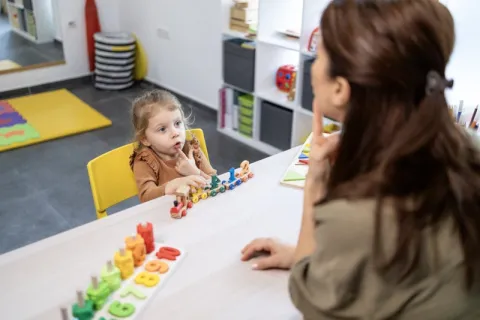

How Do I Begin a Career as a Pediatric Speech-Language Pathologist?
While approximately one in fourteen children in the United States struggles with a voice, speech, or language disorder, only a little more than half receive intervention services. By becoming a pediatric speech-language pathologist (SLP), you can help close this gap and make a meaningful difference in children’s lives.
A speech-language pathologist (SLP) is a licensed health care professional who specializes in treating communication and swallowing disorders.
- Speech disorders affect how an individual produces speech sounds
- Language disorders impact comprehension or expression of spoken or written language
A pediatric SLP specializes in working with children, adolescents, and their families. You may also hear this role referred to as a pediatric speech pathologist or pediatric speech therapist. Pediatric SLPs help children:
- Communicate effectively (verbally and in writing)
- Develop social communication skills
- Build confidence in both academic and everyday settings
Let’s explore the future of this impactful field and the pathway to becoming a pediatric speech-language pathologist.
The Career Outlook for SLPs Who Work with Children
Pediatric speech-language pathology is a rewarding and in-demand field with practice applications in early intervention, K–12 educational settings and children’s health care. A pediatric speech-language pathologist assesses, diagnoses and treats disorders that affect fluency, cognition, voice and other aspects of communication or swallowing.
The Bureau of Labor Statistics (BLS) projects an overall 15 percent increase in the number of jobs for speech-language pathologists from 2024 to 2034. This growth rate is approximately five times the average for all professions.
Factors Contributing to Increased Demand
The BLS Occupational Outlook identifies two primary reasons for the projected demand: 1) an increase in awareness of speech and language disorders at an early age, and 2) escalating needs for treating autism spectrum disorder.
Speech and Language Disorders in Young Children
In recent years, organizations such as the American Speech-Language-Hearing Association (ASHA) have advocated for universal speech-language screening for preschoolers. Early intervention means there are more opportunities to provide needed care, which requires more practitioners.
Commonly identified speech-language difficulties include:
- Delays in language development
- Articulation or phonological speech struggles
- Problems using voice
A recent ASHA survey shows that almost two-thirds of those who care for children and adults with communication difficulties could benefit from additional support. For caregivers working with children, the need is especially evident in responding to related behavioral and emotional issues. Pediatric SLPs support caregivers with professional resources, coaching and interventions that can improve care experiences and outcomes.
Autism Spectrum Disorder
A CDC report from the Autism and Developmental Disabilities Monitoring (ADDM) Network shows that the prevalence of autism spectrum disorder has increased sharply over a 20-year period. As measured in eight-year-old children, incidences surged from one in 150 children in the year 2000 to one in 36 in 2020. The CDC also points to noticeable increases in historically underserved ethnic populations.
Children affected by autism spectrum disorder often exhibit multiple or complex difficulties in communicating. Common issues SLPs treat include:
- Atypical speech or language development
- Language that frequently includes repetition or out-of-context statements or questions
- Unusual voice inflections
- Vocal outbursts
- Struggles with social communication
With increasing rates of autism spectrum disorder diagnosis, schools, families and health care providers need more speech-language resources. Pediatric SLPs work alongside teachers, parents and other professionals to provide speech-language aspects of comprehensive care.
How Pediatric Speech-Language Pathology Makes a Difference
A growing body of research demonstrates the significant effects of speech-language intervention services for children. ASHA manages a dynamic collection of evidence-based practice studies that show the transformative outcomes clients can achieve through speech-language therapy. A few examples include:
- Executive functioning and social communication development for autism spectrum disorders
- Literacy skills for pediatric apraxia of speech
- Personalized approaches for cleft palate
- Assessments for suspected speech sound disorders in preschoolers
- Written language interventions for children with academic struggles
Increased emphasis on pediatric speech-language research and practice is helping equip pediatric speech-language pathologists with proven approaches to optimize client outcomes.
The Future of SLP Careers
A breakdown of the BLS career outlook data projects that by 2034, a little more than one-third of SLP jobs overall will be in educational settings and more than half will be in health care.
Speech-language pathologists often work in teams and may coordinate with other health care professionals. One area of particularly high expected growth is health care offices that may also include audiologists, physical therapists or occupational therapists. Projections show an expected increase of more than 30 percent for SLPs in these settings.
Salary expectations for speech-language pathologists are commensurate with demand. The most recent BLS data shows the median salary in this field is $95,410, almost double the median salary for all occupations. SLP jobs in health care are the highest-paid roles in the field.
Is Pediatric Speech-Language Pathology a Good Career Fit for You?
If you enjoy interacting with people and you are motivated to help children overcome communication struggles, a career in pediatric speech-language pathology can be highly rewarding.
In addition to the specialized knowledge and skills required for speech-language pathology, many other professional qualities are important for effective practice. A successful pediatric SLP is:
- Goal-oriented. An SLP plans a course of action with measured steps to help clients achieve desired results.
- Skilled in problem-solving. Because each case is unique, a speech-language pathologist finds personalized ways to address obstacles and make the most of opportunities as they arise.
- Creative. When working with children, a pediatric speech-language pathologist uses playful approaches to keep therapy sessions interactive.
- Caring. People who struggle with communication face many frustrations in daily life. A compassionate pediatric therapist can bring transformative encouragement as children and their families persevere through challenges.
Steps to Becoming a Pediatric SLP
Entry to the profession of speech-language pathology requires multiple steps. Here is a step-by-step guide to reaching those achievements:
1. Education and Practical Experience
The first step toward SLP certification and licensure is earning a graduate degree from an accredited school that meets CCC-SLP guidelines.
Master of Science in Speech-Language Pathology (MSSLP) programs prepare students with the knowledge and clinical skills required for examination and licensure. Preparation for specialized pediatric practice includes content in child development and children’s health. If you do not have a bachelor's degree in speech-language pathology or a related field, you will first need to complete prerequisite science courses and observation hours prior to starting a master's degree program.
Clinical practicum hours are an important component of the SLP educational experience. Applicants must complete at least 400 hours of supervised clinical experience, including 25 or more hours of guided observation and a minimum of 375 hours of direct client/patient contact.
2. Examination
Applicants for certification must achieve a passing score on the national Praxis exam in speech-language pathology. The exam includes assessment across all areas of practice, including diagnosis and treatment of disorders, clinical management and research.
3. Clinical Fellowship
The ASHA Clinical Fellowship is a mentored practice experience for transition from coursework and practicum experience into full practice after graduation from an accredited SLP program. A qualified mentor provides structure, guidance and supervision. ASHA requires Clinical Fellows to complete a minimum of 36 weeks and 1,260 hours.
4. Application for Certification
Following current process standards, applicants submit the online application, along with transcripts and test scores, to ASHA. Fellows may complete this step during the Clinical Fellowship.
5. State Licensure
ASHA Certification (CCC-SLP) and state licensure are two different credentials. State licensure is the credential that allows clinical practice in speech-language pathology, and all 50 states have their own licensure requirements and processes. Further, maintaining state licensure will likely require continuing education units (CEUs) for periodic renewal. In addition to licensure and certification, additional credentials may be required in some states for specific practice settings. As a future SLP, it is important to understand the rules and regulations in the state where you anticipate practicing.
Earn Your Online M.S. in Speech-Language Pathology at St. Bonaventure and Set Yourself Up for Success
Master of Science in Speech-Language Pathology at St. Bonaventure University Online prepares you to achieve your career goal of becoming a pediatric speech-language pathologist.
M.S. in SLP online program features these benefits:
- Pediatric-focused courses, including Speech Sound Disorders in Children (SLP 600) and Language Disorders in Children (SLP 640).
- Clinical placement support and training that aligns with certification and licensure requirements.
- 100% online coursework with a mix of live and asynchronous classes.
At St. Bonaventure, you’ll also find culturally responsive training that prepares you for values-led practice in diverse settings. Wherever your professional pathway leads, your St. Bonaventure master’s degree equips you as a pediatric speech-language pathologist to deliver purposeful care that motivates children to achieve their full potential.
Frequently Asked Questions
Pediatric speech-language pathology is an in-demand field with opportunities in early intervention, K–12 schools, and children’s health care. Increased awareness of communication disorders and growing needs for services contribute to continued demand for professionals who work with children.
Demand for pediatric SLPs is increasing because speech and language disorders are being identified earlier and more children need services related to autism spectrum disorder. Greater awareness among families and educators also contributes to more referrals for evaluation and treatment.
Pediatric speech-language pathology can improve executive functioning, social communication, literacy, speech production, and written language. Evidence-based assessment and treatment allow clinicians to tailor services to concerns such as autism, childhood apraxia of speech, cleft palate, suspected speech sound disorders, and academic language difficulties.