

What Can I Do with a Master of Social Work?
Blog Updated on February 24, 2026.
Jump to:
- What are the Differences Between Generalist and Clinical Social Work?
- How Do I Become a Clinical Social Worker?
- Where Can I Make the Most Impact as a Clinical Social Worker?
- What Are the Different Types of Social Work?
- What are the Benefits of a Master of Social Work Degree?
- How Can an Online MSW Degree Advance My Social Work Career?
Clinical social workers help clients overcome mental health and other life challenges through assessment, diagnosis, and treatment. They address these challenges within the contexts of family, community, and public policy dynamics. Master of Social Work program graduates know how to support individual growth and improve their communities.
As an aspiring clinical social worker, you may want to learn more about what you can do with a Master of Social Work. Knowing where your career can go with a degree before taking the first steps is helpful. Let’s start by distinguishing generalist and clinical social work paths.
What are the Differences Between Generalist and Clinical Social Work?
The term “social work” covers many practice areas and specializations. We can generally divide the social work field into generalist and clinical roles. Social workers should consider each role's job responsibilities and education requirements as they enter the workforce.
Generalist social workers often work in and with public, non-profit, and private organizations to address social problems. The scope of practice can range from case management for families in need of housing to advocacy roles with social justice groups. Some states offer a BSW level licensure, however, professional level social work recognized by the Association of Social Work Boards (ASWB) requires an MSW. Almost all states have a master’s level professional social licensure option which supports the practice of micro and macro level social work practice. General master’s level licensure through state boards does not include authorization to diagnose or provide psychotherapy to clients independently.
Clinical social workers provide personalized mental health services to patients of all ages in a range of settings. They also possess the skills and education necessary for careers in generalist areas. State laws governing clinical social worker licensure authorize independent assessment, diagnosis, and psychotherapeutic treatment of individuals, couples, and families by clinical social workers. The online Master of Social Work program at St. Bonaventure University is a clinically focused social work program.

How Do I Become a Clinical Social Worker?
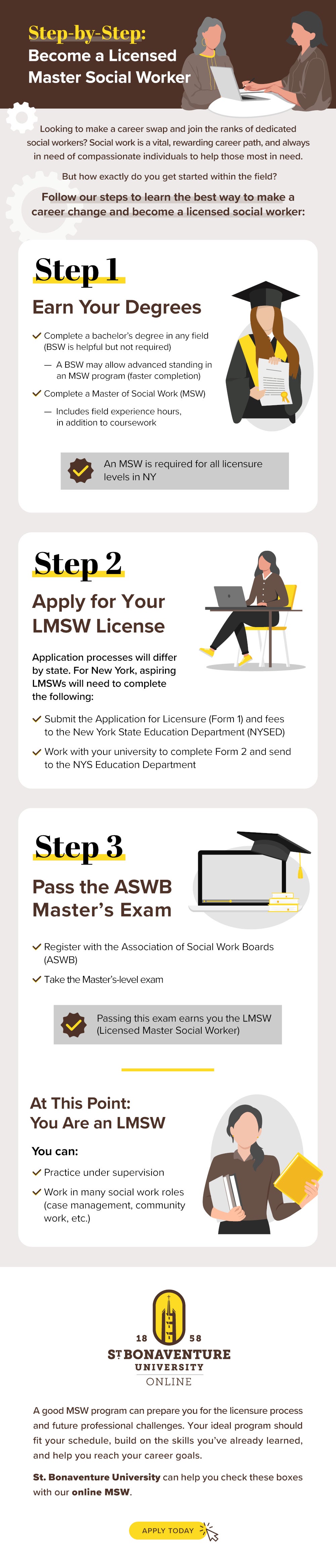
The first step to becoming a clinical social worker is completing a Master of Social Work program. Students gain the skills necessary for social work careers through advanced coursework, research projects, and practical experiences. Traditional degree programs for those who already hold a bachelor’s degree in a non-social work field take two years to complete with online programs offering accelerated paths to clinical careers. There are also advanced standing MSW programs for those who already hold a BSW to earn their MSW in a year.
State Licensure
Master of Social Work graduates apply to their state licensing board for licensure as clinical social workers. The licensing process in your state establishes baseline requirements for professional competency and behavior. New York’s Licensed Master Social Worker (LMSW) process offers a good example of state licensing requirements.
An LMSW in New York provides diagnosis and treatment planning under the supervision of a Licensed Clinical Social Worker (LCSW). The New York State Education Department requires LMSW applicants to hold master’s degrees in social work before submitting license applications. Additional requirements for prospective LMSWs include:
- Paying a licensure and registration fee of $294
- Being at least 21 years old
- Completing state-approved courses on child abuse identification and reporting
- Passing the Masters-level exam from the Association of Social Work Boards (ASWB)
Once an LMSW completes their supervision requirements under an LCSW, then they too can become licensed as an LCSW and engage in independent practice.
ASWB Exam
Social workers receive state board authorization to sit for the ASWB exam before final license approval. The ASWB offers five levels of exam - Associate, Bachelors, Masters, Advanced Generalist and Clinical - depending on applicant needs and educational qualification. The exam’s multiple choice questions are shaped by practice analysis surveys sent to American and Canadian social workers.
Exam takers complete 170 questions - 150 of which are scored - over four hours. The questions are divided into knowledge, skills and abilities (KSA) categories based on survey results. The most recent version of the ASWB exam focuses on the following KSA areas:
- Human Development, Diversity, and Behavior in the Environment
- Assessment, Diagnosis, and Treatment Planning
- Psychotherapy, Clinical Interventions, and Case Management
- Professional Values and Ethics
The ASWB exam combined with state licensing regulations protects the public from inadequate care. Licensed clinical social workers demonstrate competency through their education, licensure, supervised clinical work experience and exam scores.
Where Can I Make the Most Impact as a Clinical Social Worker?
The U.S. Bureau of Labor Statistics (BLS) projected a 6% growth in social work positions from 2024 to 2034. You’ll no doubt want to fill one of these roles while maximizing your impact on clients. Let’s start by looking at who clinical social workers serve before exploring where they practice.
Populations Served by Master of Social Work Graduates
A 2020 Mullan Institute survey of Master of Social Work graduates found that 34.9% of respondents primarily worked with children and families. This work includes interventions for young clients and support for parents navigating difficult family situations. Recent graduates also identified the following populations as their main clients:
- People with mental health disorders (25.9%)
- People receiving healthcare (11.3%)
- Students in school settings (10.7%)
- People with substance use disorders (7.7%)
Clinical social workers often work with clients confronting the consequences of social and economic inequities. Two-thirds of respondents to the Mullan Institute survey reported more than half of their clients earned below the federal poverty level. A similar-sized group noted that at least 50% of their clients were Medicaid-eligible.
Job Settings for Master of Social Work Graduates
Social workers with Master of Social Work degrees practice in a variety of settings. This variety stems from integrating social work into health care, schools and public services. The BLS identified the most common employers of social workers including:
- Private practice and family service organizations (17%)
- Outpatient healthcare services (14%)
- Local government agencies (14%)
- State government agencies (13%)
- Inpatient healthcare services (10%)
Master of Social Work Career Paths
Eighty-two percent of Master of Social Work graduates provide direct services to individuals, families, and groups. Clinical social workers primarily offer mental health services in direct-service roles.
Social workers with clinical backgrounds may oversee community service organizations. Master of Social Work programs train future community leaders to view social services through equitable and inclusive lenses. This path can lead to administrative roles with organizations advocating for affordable housing, restorative justice, and other issues impacting high-need groups.
There are also career paths for clinical social workers interested in macro-level change. You can work for health insurance providers on plan audits, non-profit organizations on program development, or with advocacy groups to advance social justice legislature. Careers with Master of Social Work degrees can be shaped based on your interests and long-term goals.

What are the Different Types of Social Work?
The social work profession is an umbrella for many different career paths. People of all ages across the United States work with social workers in public and private sector settings. Here are some of the most common types of social work, according to BLS data.
1. Child, Family, and School Social Workers
Professionals in this field of social work strengthen families through social services and counseling. Social workers focused on child and family services assist with everything from home visits to adoption procedures. LCSWs also lead counseling sessions with individuals or families to address:
- Anxiety and depression
- Child welfare concerns
- Communication issues and interpersonal conflicts within the family
In schools, social workers connect with students and their families to address issues like:
- Challenges impacting academic achievement and social well-being
- Class absences and dropping out of school
- Substance use
- Teen pregnancy
School social workers assess students for behavioral disorders and intervene during crises. They communicate with educators and provide in-service training to identify student challenges. Social workers in educational settings also maintain relationships with community service providers to better help students.
Work Settings
Child, family, and school social workers are concentrated in workplaces where interactions with children are frequent. The BLS found that this type of social work is the most common in the United States, with 352,160 practitioners in 2023. Industries with the most employees in this social work field include:
- Individual and family service providers (83,280)
- Local government agencies (69,170)
- State government agencies (67,790)
- Elementary and secondary schools (57,700)
- Community food and housing service providers (10,300)
Education and Salary
New graduates of social work programs can find entry-level work in child, family, and school social work. A Master of Social Work (MSW) and state licensure are necessary for anyone who wants to provide counseling services. MSW holders have more independence in their work and higher earning ceilings than BSW graduates.
The BLS found that the median salary for child, family, and school social workers was $53,940 in 2023. The top 10% of earners reported salaries of at least $85,590. Location matters when it comes to salaries, with the District of Columbia ($76,330), New York ($74,080), and New Jersey ($73,680) far exceeding the national average.
2. Healthcare Social Workers
Healthcare social workers, also known as medical social workers, help patients and their families navigate the healthcare system. Practitioners in this field of social work evaluate patients' ongoing health, emotional, social, and economic needs during their hospital stays. They collaborate with care providers on treatment planning and guide patients to services during and after care.
Social workers may specialize in the following practice areas based on their interests and experiences:
- Geriatric social work
- Hospice and palliative care social work
- Oncology social work
- Pediatric social work
Patients and family members often struggle with difficult diagnoses and the stresses of chronic or long-term care needs. LCSWs in healthcare settings provide counseling services to deal with these challenges. Counseling interactions range from crisis interventions in emergency departments to post-care appointments.
Work Settings
The healthcare industry is diverse, offering many workplaces for healthcare social workers. The BLS estimated that 185,020 professionals worked in this field of social work in 2023. The most common workplaces for healthcare social workers include:
- Hospitals (45,010)
- Home healthcare service providers (24,740)
- Individual and family service providers (23,700)
- Nursing care facilities (14,950)
- Outpatient care centers (12,250)
Education and Salary
A BSW is necessary for case management roles in healthcare settings, but most organizations prefer that candidates hold an MSW. Healthcare social workers can strengthen their credentials with certifications like the Certified Social Worker in Health Care (C-SWHC) from the National Association of Social Workers (NASW). A Basic Life Support for Healthcare Providers certification is also useful in case of medical emergencies.
The median salary for a healthcare social worker in 2023 was $62,940, according to the BLS. Top earners in this social work field reported salaries of at least $97,790. The places with the highest salaries for healthcare social workers are California ($93,200), the District of Columbia ($87,860), and New Jersey ($82,010).
3. Mental Health and Substance Abuse Social Workers
LCSWs are trained to provide mental health screening and treatment. They evaluate clients for psychological and behavioral disorders, provide therapeutic services, and collaborate with other providers to develop individualized treatment plans. This social work field is particularly important given the following prevalence of mental health disorders according to the National Alliance on Mental Illness (NAMI):
- Anxiety Disorders (19.1% of U.S. adults in 2024)
- Major Depressive Disorder (15.5%)
- Post-traumatic Stress Disorder (4.1%)
- Bipolar Disorder (2.8%)
The Substance Abuse and Mental Health Services Administration (SAMHSA) estimated 16.8% of Americans aged 12 or older had a substance use disorder in 2024. Social workers can specialize in providing counseling and case management services for clients dealing with substance use disorders. This type of social work involves client counseling and assessment, along with public education efforts specific to local substance use. Social work professionals in this field also help their clients through co-occurring health challenges.
Work Settings
Mental health and substance abuse counselors may work in private practice or as part of a larger organization. A BLS estimate from 2023 identified 114,680 professionals working in this social work field. The most common industries employing mental health and substance abuse counselors include:
- Outpatient care centers (23,620)
- Individual and family service providers (15,780)
- Health practice offices (14,000)
- Local government agencies (13,070)
- Residential mental health, substance abuse, and developmental disability facilities (11,430)
Education and Salary
Practitioners in this social work area need MSWs and LCSW state licensure because of their focus on client counseling. MSW students interested in treating mental health and substance use disorders gain experience during their supervised clinical hours. Industry organizations like NASW offer certifications related to this social work field that build on graduate studies.
The median salary for a mental health and substance abuse social worker was $55,960 in 2023. BLS data found that the top 10% of earners in this specialization earned at least $100,090. New York has the highest median salary at $92,470, while California ($81,330) and Connecticut ($77,930) round out the top-paying states.
What are the Benefits of a Master of Social Work Degree?
The positive impacts of social workers on community life translate into high job satisfaction among recent graduates. The 2020 Mullan Institute survey found a 90.4% job satisfaction rate for new social workers. Eighty percent of respondents intended to become clinical social workers in five years in part because of career fulfillment.
Social workers also earn higher salaries in jobs requiring Master of Social Work degrees than other degree options. A 2024 workforce study of social work graduates found a 16% higher average salary for social workers with master’s degrees compared to those with bachelor’s degrees. The BLS determined that the top 10% of earners in the social work profession made $99,500 or more per year.
You can unlock the benefits of social work careers by completing your graduate degree at a leading university. The ideal Master of Social Work program includes experienced faculty, flexible schedules, and coursework relevant to today’s challenges. St. Bonaventure University offers a Master of Social Work degree that checks these boxes.
How Can St. Bonaventure University Advance My Social Work Career?
Our Online Master of Social Work is an innovative program with 100% online coursework, and is available both for those who hold a BSW and those with a bachelor's degree in another discipline. Graduates of the Master of Social Work program carry our core values of compassion, wisdom and integrity throughout their careers.
Our program’s courses and practicum hours are divided between foundational and advanced years. Those who already hold a BSW only need to complete the advanced year.
In the foundational year, students complete 400 practicum hours and courses like Human Behavior in the Social Environment and Social Work Interventions. The advanced year curriculum includes 500 practicum hours and coursework including:
- Clinical Practice with Families
- Integrated Clinical Assessment and Differential Diagnosis
- Social Policy, Justice, and the Law
- Trauma-Informed Clinical Social Work Practice
We offer a great return on investment for your time, energy and money. Tuition for the online Master of Social Work is competitive among other programs in the discipline. Bonnies across all academic disciplines benefit from our strong reputation including the following regional ranks from the 2025 U.S. News & World Report:
- No. 8 in Best Value School (North)
- Top 20 Regional University (North)
SBU’s Online Master of Social Work differs from other human services degrees by focusing on the person-in-environment perspective. Faculty work with students on understanding client needs within the context of individual identities, families, communities, and society. This focus supports a holistic approach once graduates enter the workforce.
Frequently Asked Questions
Generalist social workers address social problems through public, nonprofit, and private organizations and may work with individuals, groups, organizations, or communities. Clinical social workers provide assessment, diagnosis, and treatment for mental, emotional, and behavioral concerns and typically need an MSW and state licensure.
The first step to becoming a clinical social worker is completing a Master of Social Work program. Students gain the skills necessary for social work careers through advanced coursework, research projects, and practical experiences.
Master of Social Work graduates apply to their state licensing board for licensure as clinical social workers. The New York State Education Department requires LMSW applicants to hold master’s degrees in social work before submitting license applications.
Social workers receive state board authorization to sit for the ASWB exam before final license approval. The exam’s multiple choice questions are shaped by practice analysis surveys sent to American and Canadian social workers.
Clinical social workers can make an impact in hospitals, mental health centers, substance use treatment programs, schools, government agencies, nonprofits, private practices, and community organizations. The most suitable setting depends on the populations and issues a social worker wants to address.